
UZAKARA LETTERS
Five Playhouse Games for a Week of Stories
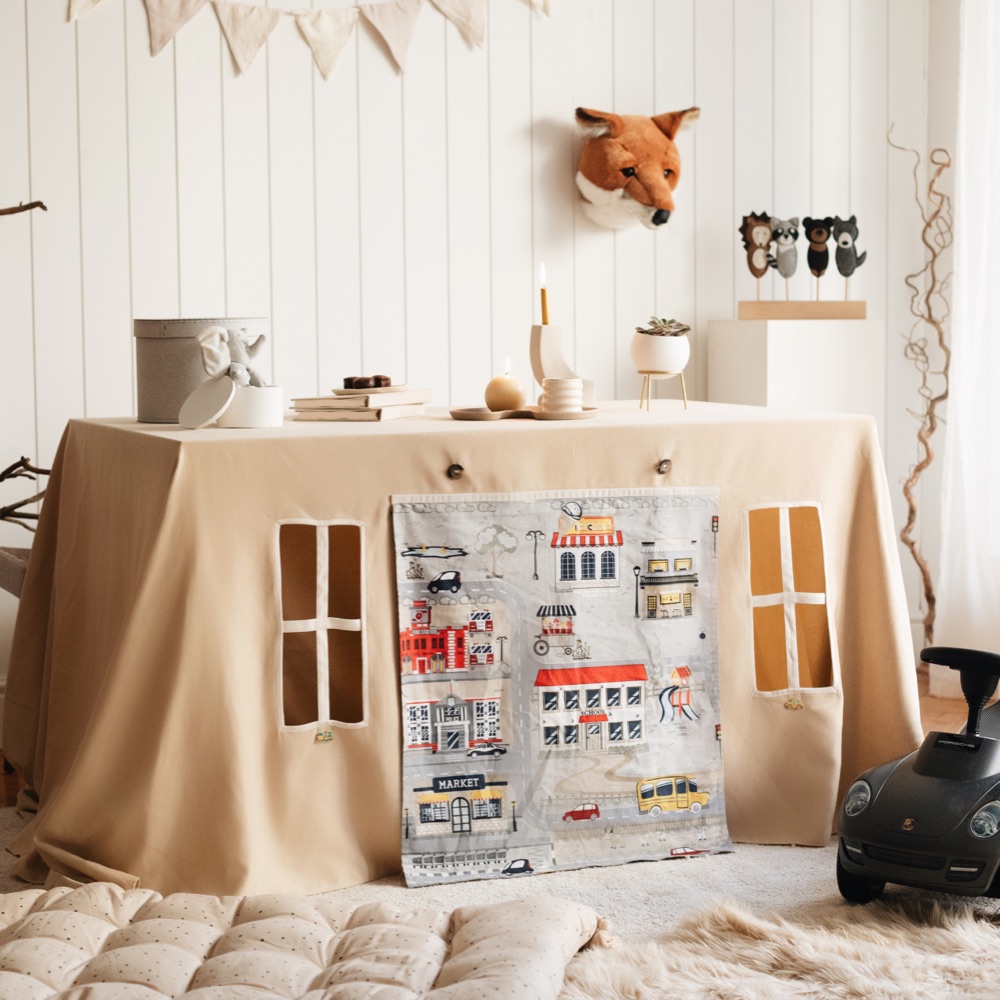
Sometimes the hardest part of playing together is the first sentence. A child has a whole imaginary world waiting; an adult has laundry to finish and a slightly blank look when asked to be a dragon. A small playhouse can help. Put the cloth over the table, choose a door, and suddenly there is somewhere for the story to begin.
These five games need very little preparation. The point is not to perform them perfectly or stretch them into a lesson. Let the story take a turn you did not expect.
Monday: A shop that sells impossible things
Open a little shop inside the playhouse. Instead of money, customers pay with made-up words, silly walks or songs. The shop might sell jars of moonlight, maps to places that do not exist, or a spare minute for somebody having a difficult day.
Start by asking, “What is the most unusual thing on your shelf?” Then become the first customer. Younger storytellers can name an object; older ones can negotiate, invent a receipt or decide what happens when the shop runs out.
Tuesday: A package with no name
Leave an empty box outside the door. It has no address and no clue about who sent it. What is inside? Whose package could it be? How can the characters return it without knowing whom to ask?
The box can remain empty. The discoveries are in the conversation, not the props. If the story gets stuck, offer two possibilities: it belongs to a lost explorer, or it is a gift for a neighbour nobody has met.
Wednesday: The weather report from another planet
One player is a weather reporter looking out from the playhouse window. Today’s forecast might include falling feathers, purple clouds or a light breeze that makes everybody speak in rhyme. Another player is preparing to go outside. What will they wear? What will they carry? How will they travel?
Invite a family member to give a one-minute broadcast. The forecast will almost certainly change halfway through. That is part of the game.
Thursday: The neighbour who cannot find the door
A character arrives, but they do not know how to enter. Perhaps they are very large, very tiny, very shy or carrying something awkward. The people inside must solve the problem together. Can the door become a bridge? Is there a secret entrance? Does someone need to explain the house rules?
It is a small way to play with perspective: the same house feels different depending on who is visiting. No special script is required.
Friday: The audience chooses the ending
Use the playhouse as a stage. A character finds a key and has to decide whether to open a mysterious door. Pause the story just before the choice. Everyone watching votes on what happens next. If you have puppets, let them argue about the choices. If not, a sock, a drawing or a very serious adult hand makes an excellent character.
Try the other ending afterwards. A story does not have to finish in the same place twice.
Make room for the unexpected
You do not need five evenings in a row, an elaborate set or a box full of new toys. Begin with one invitation and stop when everybody has had enough. The playhouse supplies a setting; the people inside supply the world.
If you would like to see the textiles behind these little worlds, explore the Uzakara shop. For the idea behind a playhouse made from an everyday table, read A Little House, a Hundred Stories.