
UZAKARA LETTERS / WHY THIS?
A Little House, a Hundred Stories: The Wonder of a Playhouse
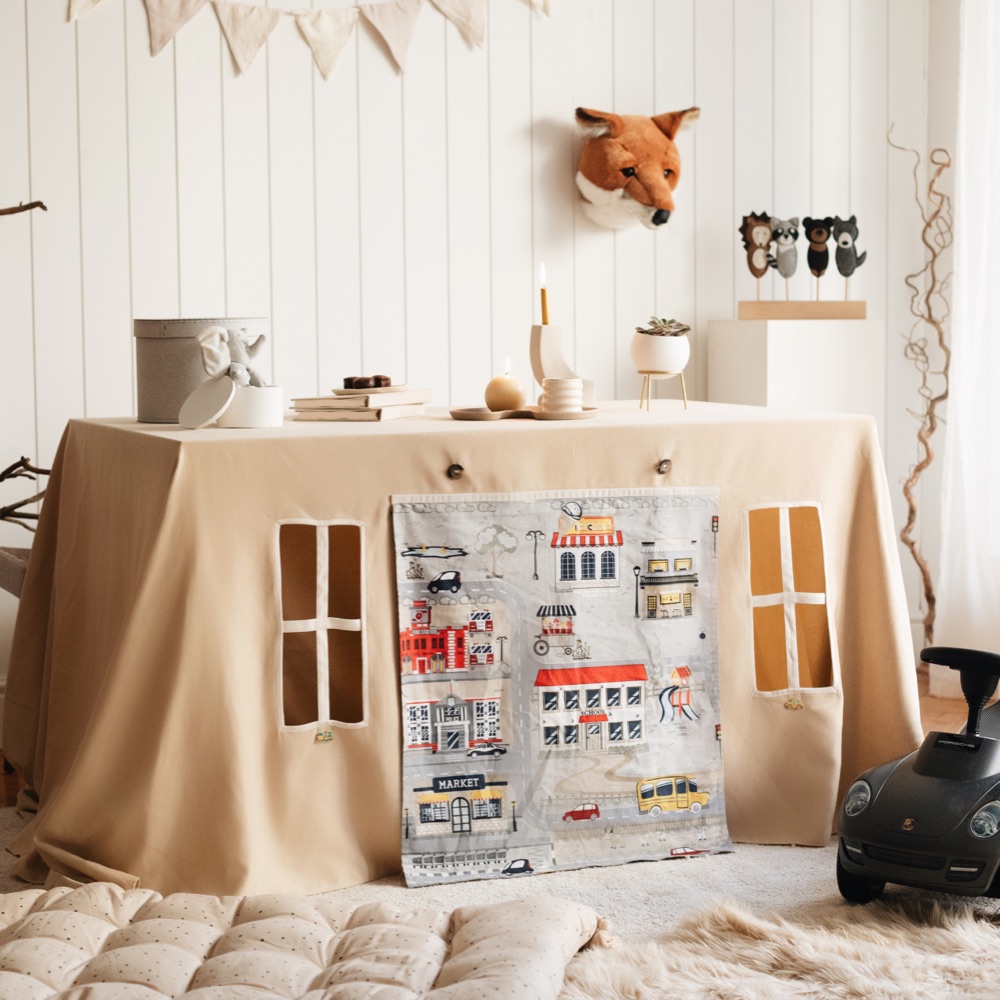
Every room has an everyday role. A dining table is where a meal happens, homework spreads out or someone leaves a book. But seen from a different height, the same table can become something else entirely: a little street, a hideaway, a house with its own front door.
That small change of perspective is the idea behind a textile playhouse. Instead of asking for a dedicated room or a large permanent structure, it borrows the furniture already there. Put the fabric in place and the familiar becomes a setting for somebody’s imagined world.
Build a world, not a script
Open-ended play is interesting because the story can keep changing. A doorway can lead to a bakery one day, a library the next, or a place that doesn’t yet have a name. The house creates a boundary and a sense of place. The child supplies the characters, the problem and the ending.
The National Association for the Education of Young Children describes play as an important context for developing language, relationships and problem-solving. That doesn’t mean a particular playhouse produces a measured developmental result. It means the shared activity, the conversation and the child’s own choices are what matter.
Look at the little details
There’s a reason we keep coming back to the City Life Playhouse. Its city-inspired surface suggests a place in which a story could happen. A child might invent a shop, a customer, a neighbour or the world’s smallest adventure.
The Rose Garden Playhouse takes the same simple idea in a softer direction. And Under the Stars opens a door to stories after the lights come down. They are different visual settings, not scripts that tell anyone how to play.
Before choosing one, check the individual product photos, dimensions and care information. A fabric playhouse that fits one table or room won’t necessarily suit another. Always consider the child’s age, supervision needs and the maker’s guidance.
Three invitations to start playing
Someone has just arrived
Who is at the door? Why have they come? The surprise can be as small as an unexpected parcel or as big as a dragon looking for directions.
The neighbourhood needs a name
Ask the storyteller to invent the street, the shop, the people who live there and one very unusual rule. Write the answers down or simply keep the game moving.
Tomorrow, everything changes
Return to the same playhouse with a different character or a new problem. The setting stays recognizable while the story grows. Repetition can be part of the pleasure.
An object can make space for imagination
UNICEF’s parenting resources about play offer accessible ideas for ordinary, low-cost imaginative activities. A textile house isn’t necessary for make-believe; a sheet and some chairs can be a wonderful beginning. What a carefully chosen object can do is give that activity a familiar home, ready for the next story.
That is what we look for at Uzakara: an object that is useful, inviting and open to being made personal. Our Tale of Magic collection is full of prompts for adventures that only their owners can invent.
Reading and references: NAEYC, Play; UNICEF Parenting. Product descriptions and photography: Tale of Magic products in the Uzakara catalogue.