
UZAKARA LETTERS / WHY THIS?
Why This? A Little Stage With Room for Big Stories
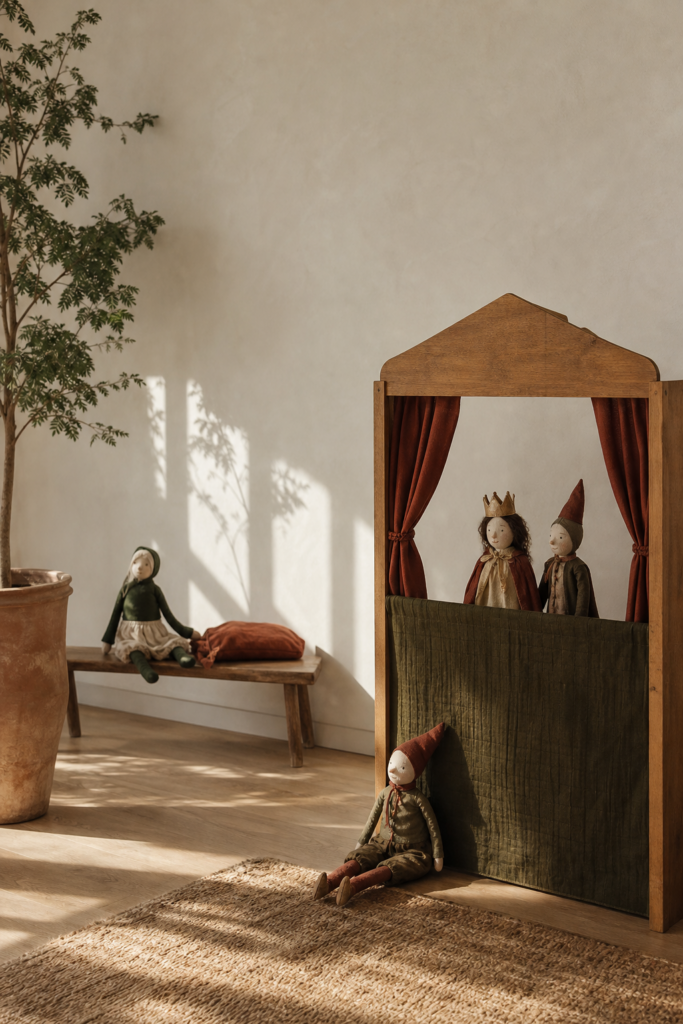
A puppet can make an entrance from behind a chair. It can speak from inside a cardboard box. Give it a voice and it is suddenly somebody.
So why give that character a stage?
Not because children need another elaborate set of instructions. Quite the opposite. A small theatre provides one simple boundary between what the audience can see and what the storyteller can imagine. Everything else can change.
A frame is not a script
Picture a stage with two puppets. One is hiding. The other has arrived carrying a problem. Who knows the answer? Perhaps nobody. Perhaps the audience has to decide.
In that moment, the wooden frame does almost nothing. It holds its position, leaving the children to decide when a character appears, where a scene begins and what happens next.
Good play objects sometimes become useful by declining to do all the work.
That distinction matters in a world of toys that arrive with their own soundtrack, storyline and rules. There is pleasure in being shown a complete performance. There is a different pleasure in inventing one.
What the play research actually says
It is easy to exaggerate claims about creativity and child development, especially when those claims help sell a toy. We prefer the more modest evidence: imaginative play can create opportunities for language, communication, shared attention and storytelling.
In its 2026 report on the power of play, UNICEF emphasises that playful interaction and even simple everyday materials can support learning and creativity. The National Association for the Education of Young Children includes retelling stories with puppets among the ways preschoolers work with language and literacy.
Neither source suggests that owning a puppet stage is a requirement. A folded blanket can make a curtain. A table can become a theatre. The useful principle is space for people to take an active part.
A thoughtfully made stage is simply one way to give that activity a place to return to.
Three ways to begin without a script
1. Give the wrong character the right problem
Ask a shy dragon to deliver an important message. Ask a brave rabbit to look after something fragile. Give them a challenge that does not match their usual story. The mismatch is often enough to get a conversation going.
2. Hide the next scene
Let one character disappear behind the stage and return with a small change. A paper crown, a funny new voice, a borrowed hat. What happened backstage? The audience gets to guess.
3. Let the audience interrupt
Instead of finishing every line yourself, stop just before the difficult choice. Ask the audience what the puppet should do. Try an answer, change your mind and begin again. This is play, not a graded performance.
Look at what the object leaves open
The Wooden Puppet Stand in Uzakara’s Tale of Magic collection is a straightforward example of an object whose form suggests an activity without deciding its outcome.
Before choosing a stage, consider the real questions: where will it live, how much room does it need, what age and supervision are appropriate for the particular item, and does it suit the puppets already in use? Check the product’s dimensions and maker details rather than assuming every theatre fits every home.
The best play object is not always the most elaborate one. Sometimes it is the one that can accommodate the greatest number of stories, including the unexpected ones.
A little stage is a lovely place to discover that the story belongs to whoever is telling it.
Further reading: UNICEF, The Power of Play (2026); NAEYC, Language and Literacy in Preschool; UNICEF, Play Corner.