
UZAKARA LETTERS / WHY THIS?
Why This? The Beauty of a Material’s Second Life
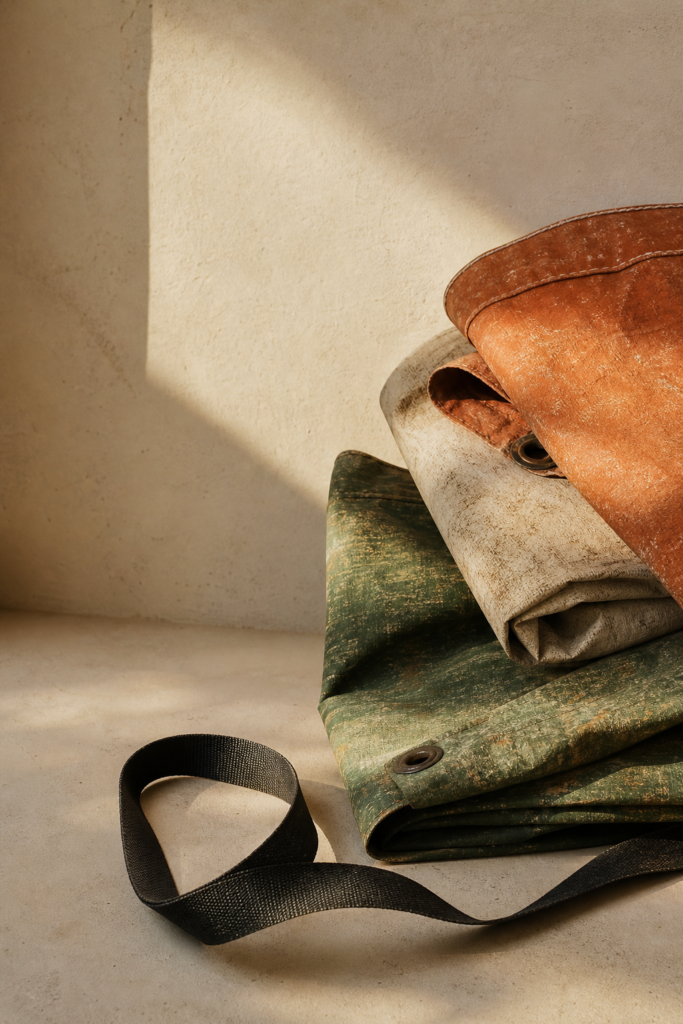
One of the easiest ways to make an object disappear is to make it look like every other object. Smooth the surface. Remove the marks. Match the trend. Repeat.
And yet the objects we return to often have something less obvious in common. They give us a reason to look twice.
A fold that follows the way a material behaves. A seam reinforced where the weight will pull. A colour variation that could not have been ordered from a swatch book. The story is not printed on a label. It is present in the thing itself.
What can a material remember?
Take a truck tarpaulin. In its first life, it was meant to cover a load, face the weather and survive repeated use. Its job was practical. Once retired, it might be discarded even though useful sections remain.
Loading Bag works with salvaged truck tarps and advertising banners. The maker explains that pieces in the same pattern can come from different former surfaces. A bag assembled from one reclaimed panel may have a mark or colour arrangement that no second bag will share.
That difference is not a manufacturing error disguised as charm. It follows directly from the source material.
But a compelling backstory is only the beginning. The material still needs to do the job. The strap has to carry a load. A closure has to be useful. The stitching should make sense. An object earns its place in daily life by working, not merely by making a persuasive claim.
Upcycled is a method, not a magic word
The difference between reuse and a fashionable sustainability slogan matters. Turning an existing panel into a useful bag may extend its working life, but it does not by itself prove that the finished object is carbon-neutral, endlessly recyclable or impact-free.
The Ellen MacArthur Foundation describes circularity through three design principles: eliminating waste and pollution, circulating products and materials, and regenerating nature. For an individual object, those ambitions invite practical questions. What was reused? What new components were needed? Can the object be maintained? What will happen when it wears out?
Those questions are more interesting than a vague green badge. They ask a maker to explain the choices rather than simply declare a virtue.
The detail worth noticing
Look closely at the Urban Rolltop 26. In the maker’s product description, reclaimed truck tarp forms the shell, while salvaged seat-belt webbing forms the straps. The point is not that everyone needs this particular backpack. The point is that the previous purpose of a material can inform the next one.
A tarp has already been asked to endure weather. Seat-belt webbing has already been engineered around strength. Their new context changes the silhouette and the use, but it does not have to erase the logic of the materials.
Of course, none of this removes the need to inspect fit, comfort, finish, care instructions or stock availability before buying. A compelling object should welcome practical scrutiny.
Why it might stay with you
There is another form of durability beyond physical toughness. The Ellen MacArthur Foundation calls it emotional durability: designing things to remain relevant and desirable over time, not just to resist wear.
That idea explains something about taste. An item we chose for a particular reason can outlast the moment that made it fashionable. We know what drew us to it. It has a character that a newer release cannot automatically replace.
At Uzakara, this is one version of our favourite question: Why this? Not why is it new, or why is it everywhere. Why does this object deserve space in your ordinary day?
Sometimes the answer begins with a material that has already been somewhere else.
Explore the objects
See the individual pieces in our Loading Bag collection. Reclaimed material makes every piece a little different. The photographs show the character that makes each one its own.
Further reading: Circular Economy Principles; Designing Products to Be Used More and for Longer; Loading Bag maker’s collection and material descriptions.